• The CraftSessions Story
  • Our Past Retreats
  • Blog
  • Newsletter
  • Contact
Menu

The Craft Sessions

Street Address
City, State, Zip
Phone Number

The Craft Sessions

  • About
    • The CraftSessions Story
    • Our Past Retreats
  • Blog
  • Newsletter
  • Contact

It's not that you can't do it!

March 14, 2014 thecraftsessions
20131027-457.jpg

So I was at kinder pickup the other day and we were talking about sewing, and I heard that classic ripper of a line "I'm terrible at sewing. I just can't get it." And I did what I always end up doing. Saying something along the lines of "Patterns that are around these days are fantastic as they teach you as you make." "The diagrams are better and you learn techniques as you sew" (as opposed to old school patterns that assumed that you knew the techniques required). And then "it isn't actually difficult - it just requires a bit of practice".

Anyway it got me to thinking about how many people have said something along those lines to me AND got me wondering why. Why people think they are bad at it and that they can't learn how. And why does there seem to be a perception that you either have what it takes to learn to make or you don't*.  

There is this Elizabeth Zimmerman quote that I can't for the life of me find (and I am about to butcher) but it basically says that she has heard people say that they can't knit. Piffle she says! They can balance their cheque book, drive a car and make a meal. Knitting is easier than all those things. They may not want to - but it isn't that they can't. End of butchered quote - my apologies lovely Elizabeth!

When thinking about the why we don't think we can make anymore I have been thinking about what has changed in society and I think there are some clues there. I acknowledge that there is less knowledge floating around in the community these days about domestic handcrafts such as sewing. Whereas once you would have learnt sewing and knitting from your family (aunts, grandmothers etc) or even from school, nowdays those avenues for knowledge gathering are not available to most of us. And in the past there was more making around us. Due to necessity and the lack of disposable clothing and income, people mended and made as part of their daily life. It wasn't a hobby but a necessity. 

However, I think what has been lost - the thing that leads to all these comments - is more subtle than just a loss of skills. 

I think we have lost the belief that we can make.  And that making with our hands is learnable.

We aren't talking about making couture. We are talking about making a frock. Or a quilt or a cardy. None of it is really hard either. It is learned skill on skill with practice. But I think that that loss of belief is the key. And I think maybe that it comes from your childhood. From people around you just making as part of their day. From most people making as part of their skill set - like most people cook or drive, or do their online banking.

I'll give you an example from another craft to demonstrate what I mean. This guy I know, let's call him Will**, grew up in a family of tradies. He isn't one. He has always worked in corporate job. But he does all his home maintenence and he builds stuff. Sheds, chicken houses, rewiring lamps, making bunks - you name it and he will have a go at it. Even if he hasn't done it before, he gets on to the internet and figures it out. "How to hang a door" was one of the many tutorials I have seen Will look at over the years and he did a slow but fantastic job. He isn't phased by something he doesn't know about to do with building, because he believes he can learn it. He finds a person who can teach him or a book or an internet tutorial and off he goes....

I was lucky enough to grow up with a mother that is a sewing teacher. And yes I learnt to sew when I was small. BUT the skills that I have now have pretty much all been learned as an adult over the last ten years. I sew differently to my mum. She thinks the way I put my waistbands on is much harder than it needs to be. I would argue that it gives a nicer finish. Although she can knit I didn't learn from her. I learnt from youtube at when I was nearly 30 and now I am much more a knitter than she is. What I did get from her though was so key - and that was the belief that I could learn it if I tried and practiced. 

So how do you get the belief if you don't have it? I don't know..... I know that some encouragement helps. And being pointed to some good resources on the internet is also useful. I think that there needs to be a bit of an education on how not-tricky it is, but what else?? 

Am I on to something? Do you feel like this, or have you? And what helped you become a maker?

Felicia

* I should qualify this by saying that it is inevitable that the odd person really won't be able to get it. But definitely not most. 

** not his real name ;)

In Thoughts On Craft
10 Comments

The secret to becoming a great knitter!

February 7, 2014 thecraftsessions
This cardy was the first time it kinda made sense to me.

This cardy was the first time it kinda made sense to me.

The thing is that I'm not kidding with my heading. There is a secret....and I have no idea why it is a secret. Nor do I have any idea why noone talks about it or writes about it. Drives me a little nuts. So this is the post my friends when all is revealed. This is the post I have been meaning to write since the blog began.

See if any of this describes you. You might be an OK knitter. You might be a good knitter. You have been knitting for a few years (1 or 3 or 10 or even 40). You might be able to increase and decrease and have the skills to do an icord or a cable or a X or a Y or a Z. You have some skills. Whatever it is that you can do, means that you make pretty things - that people compliment you on. You like knitting. You may LOVE knitting! 

BUT one of these things other things is also true. While you are knitting you lack a bit of confidence. You worry about dropping stitches or misreading instructions. You worry about loosing count. You worry that you will lose your place. You worry that when you make a mistake you won't understand it well enough to fix it. You are scared to rip the knitting off the needles, so you tink back row after row, just to fix a one stitch mistake. You think that when you lose your place there is no way of figuring out where you are at, so you just need to fake it and maybe measure it with a tape measure, and guess a bit. You really want to try that lace pattern but don't have the headspace for all the counting at the moment. I could go on but I think you get it.

You have some fear. You have some tension in your body, and possibly in your heart as you knit. And you definitely have some worry. Knitting doesn't feel glorious and free and meditative all the time. It often feels a bit stressful and causes angst.

The thing is - you should never have to count your rows or your stitches* - except to do the odd stitch count to make sure you are on track. You should never knit with fear in your heart. You should be able to knit something in pattern without having to worry about finishing at a particular point so you don't get lost. You should be able to put something down for a year and pick it up and figure out where you are up to by looking at the knitting - not the pattern!! 

So let's get to the secret because this answer will truly set you free - free from all the grief and angst and pain.....

A favourite knit - Immie Tee by Carrie from Madder Made.

A favourite knit - Immie Tee by Carrie from Madder Made.

You need to .............

Learn to read your knitting!

This post is the start of a little mini series called - Learn To Read Your Knitting - where I tell you all I have learned over the last 10 or so years about the structure of knitting and why you should care.

So what does that even mean in reality?? And why is learning to read your knitting such a big deal?

Learning to read your knitting means that you will understand the structure of the piece you are working on. And structure is the key to becoming great at knitting - taking your knitting to the next level so to speak. You will be able to see if you have made a mistake and you will be able to see where the mistake was. And what it was. You will be able to fix things. You will rarely need to count in your head (except for the odd stitch count here and there), or tick off the number of increases you have done on the pattern. You will be able to alter your garments because you understand the structure of what you are making. You will be able to recover a garment that got left in your bag, slipped off the needles and then was chewed on by a toddler/dog.

Knitting will just be about joy **! You will be free!

Now this will take some time - it has taken me a few years! It will take some thought. And it will take some practice. I'm going to try to help - but really you can do this yourself. You really can. It is something you learn bit by bit. You will learn through your mistakes. You will learn through practice.

You can do this from wherever you are in your knitting career - complete beginner or capable knitter. You should only attempt to do it when you are knitting with light- or mid-coloured not-super-fluffy yarn, and this is a no-alcohol, no-exhaustion type situation. It calls for a clear head! 

Today's post will be obvious to some of you, but I know there are others of you who still see it as a bit of a mystery. Hopefully this helps. Don't expect that it will all make sense after reading through this once. Just start taking notice and it will make sense in time. 

Also when you are starting to read your knitting ignore garter stitch. I know it is a recommended stitch for beginners, and you can still knit it, but don't attempt to understand it till you have got the basics. (In my opinion a much better starting project for beginners is a 3 x 3 or 4 x 4 rib cowl or hat or scarf because you can see whether you need to do a purl or a knit stitch next and start understanding structure from day 1.)

The beautiful Clara - an all time favourite.

The beautiful Clara - an all time favourite.

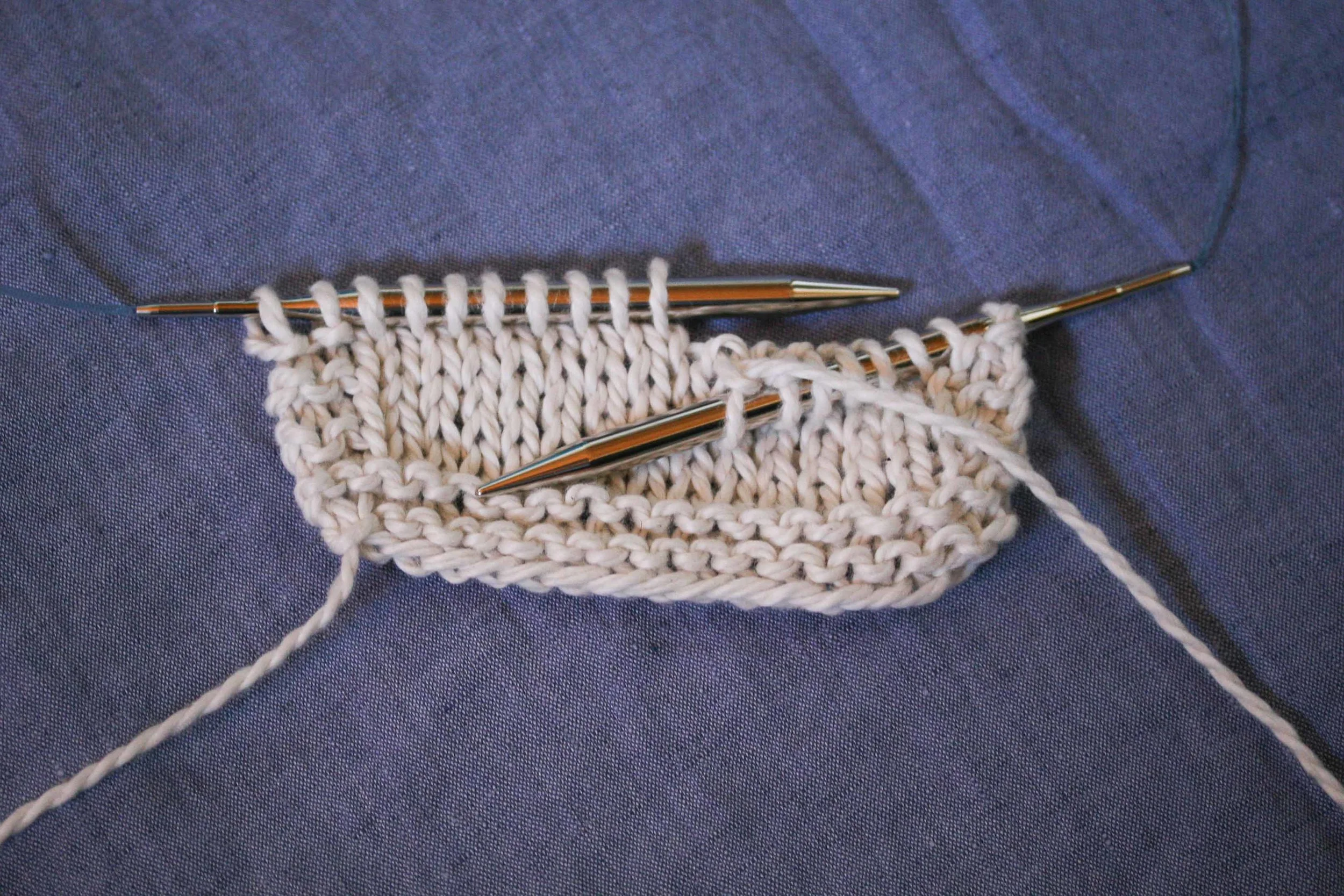
I am going to start writing about it using a yarn I had to hand - not perfect because it does have a little twist in it - and if I had time I would redo the photos and use a different colour for the yarn for the row just knitted....next post I promise - the photos will be better!  We are starting with stocking stitch - the most basic knit fabric.

Our sample is knitted at a loose gauge on needles that are too big so we can really see the structure!

Our sample is knitted at a loose gauge on needles that are too big so we can really see the structure!

Read Your Knitting - Part 1

1. The basic structure of knitted fabric.

The first thing you need to learn is the simplest and most important lesson. Everything hangs on this - the structure of knitting is really just a loop (from the current row) pulled through a loop (of the row below) pulled through a loop (of the row below that) pulled through a loop (of the row below that!). The way in which the loop is pulled through the loop means that you get either a knit or a purl stitch. If you pull the loop from the back through to the front you get a knit stitch. If you pull the exact same loop from the front to the back you will get a purl stitch.

A loop pulled through a loop pulled through a loop. The loop shown is a knit stitch BECAUSE it was pulled from the back through to the front - see how it pokes forward/up.

A loop pulled through a loop pulled through a loop. The loop shown is a knit stitch BECAUSE it was pulled from the back through to the front - see how it pokes forward/up.

2. How the stitch sits on the needle.

Start by noticing that when you have stitches on the left needle, that the right-hand side of the stitch is on the front of the needle. This is super important to get. To really get this, have a look at the next stitch on the left needle. The right-hand side of the stitch will be on the front of the needle. If you now grab the right needle tip and poke it into the front of the stitch on the left needle (as if to knit) but then stretch the two needle tips a few mm apart, you can see that there is no twist in the stitch. 

The right hand side of the stitch is on the front of the needle.

The right hand side of the stitch is on the front of the needle.

The right-hand side of the stitch travels down into the right-hand side of the hole of the stitch in the row below. The left-hand side of the stitch which is was on the back of the needle, travels into the left hand side of hole of the stitch below.

Learning this means that you can put stitches back on the needle without twisting any. Right hand side on the front of the needle - simple.

3. The knit stitch

Look at the structure of the knit stitch. Use stocking stitch!! (not garter or you will confuse the beegeezus out of yourself). It simply is a loop of yarn pulled up through a loop of yarn pulled up through a loop of yarn. This is the basic reason why the fabric created by knitting is so awesome. It allows you to ladder a stitch back to where a mistake was way down below and fix it. It also allows a whole heap of other stuff that I won't confuse you with just yet. 

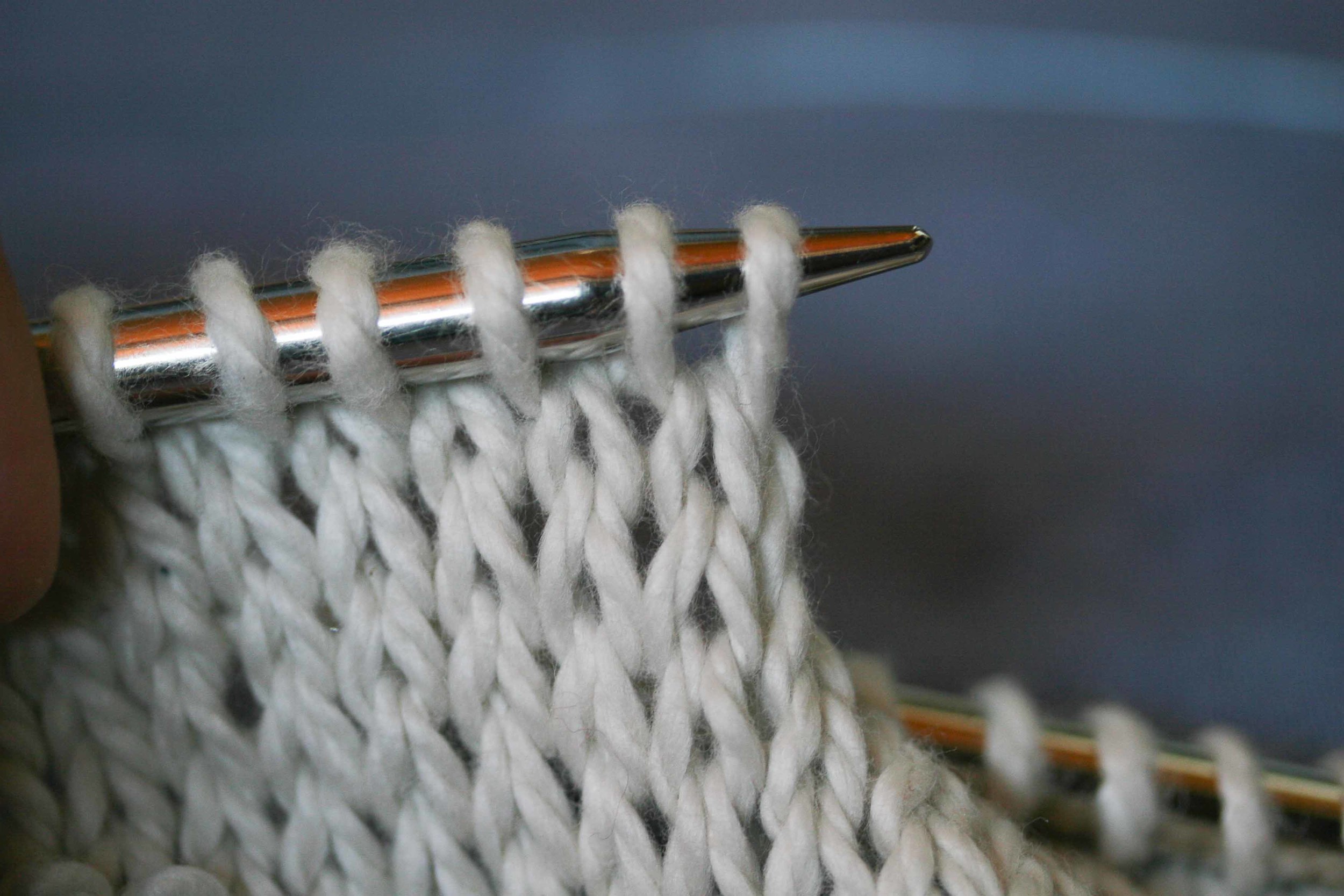
You can see the V by looking at the row just below the stitches that are on the needle. 

You can see the V by looking at the row just below the stitches that are on the needle. 


So just look at what it is. Really look! Have a look at how each stitch creates a V at the bottom and then has a loop at the top that travels behind the stitch directly above it in the next row - kind of hooking it in place. 

Notice that the back of the knit stitch (so on the wrong-side (WS) of your work) is the top of the loop - and that loop is kind of hooked around the stitch that is pulled through it to make the row above.

4. The purl stitch

Next look at what a purl stitch is doing! The reason you do a purl stitch in stocking stitch is so that all of your stitches face the right side of the fabric which gives you the nice flat fabric. So you need to change from a knit to a purl stitch on the WS of your fabric. This means you are pulling the loop from the WS through to the right-side (RS) or in other words from the front-facing-you to the back-which-is-the-right-side.

Confused yet? Reread it and better yet try it on some light coloured knitting you have lying around.

The loops seen from the purl side. You can also see how the stitch below holds the new loop in place.

The loops seen from the purl side. You can also see how the stitch below holds the new loop in place.

5. Take notice

The last point for this week is just to take notice when you do something. Of what any stitch looks like - just before you knit it, straight afterwards, on the next row and the one after that. When you decrease, look at how the stitch looks from the front on the row that you are knitting. Have a look at the same stitch after you have done the next row. If you need to then you can grab a safety pin and thread it around the stitch you made. This will make it easier to see what it looks like on the next row. This will take time but really learn what it looks like.

Practice this and all the good stuff will come. Over time it will make sense. Maybe not on day 1 or 2 or 10 but it will come.

As always I'd love to hear your thoughts - good, bad, whatever. Tell me if my pictures aren't clear. I have no idea how to write on an image so as soon as I figure this out it will be a little easier. Are you up for more posts like this?  

Felicia x

UPDATE: I'll keep linking here as I create more.

Learn to Read Your Knitting - Part 2 - Decreases is up! 

Learn to Read Your Knitting - Part 3 - Increases is up!

*there are rare occasions but they should be rare!

**obviously this is a small exaggeration because of the pain inherent in any creative pursuit ;)

In How To, Thoughts On Craft Tags knitting
125 Comments

Craft as comfort, craft as art?

January 29, 2014 thecraftsessions
Knitted this cardy last week after I got obsessed with trying to figure out how to make shoulder shaping a bit like Primoeza. Not quite figured it out but partway there. I now need to knit another. 

Knitted this cardy last week after I got obsessed with trying to figure out how to make shoulder shaping a bit like Primoeza. Not quite figured it out but partway there. I now need to knit another. 

So I stumbled across this video of Marina Abramovic* on youtube today (as you do?) and it clarified something to me about how craft fits into my life. I have wondered in the past what is the point of it all. Is it just the actual act of making? Is it just to make things?  Is it to make useful things? Why do I get so obsessed with following through on a particular idea? Why do I feel the need to have something in my hands on a long train trip? Why do I feel a bit pannicked when I forget said project? Why do I completely loose myself in the moment when I am taking photos or choosing fabrics for some new idea? Why am I sometimes unable to force myself cook (another) dinner because I want to work on some particular project? Why is it that i would much rather make a tee shirt for my small boy than chuck down $10 on one from Bonds? What is it all about?? Why is it such an important part of my life?

Marina is talking in the clip about art and being an artist. Which I am not. BUT I do recognise the feeling she describes at the start of the clip. And it gave me some words to describe what it is all about.  

FeliciaSemple1.jpg
FeliciaSemple2.jpg

Craft as art - this is the obsessive joy part of craft for me. Marina defines it as an urge to create. I think I think of it using different words usually, but it is the urge that she describes that is such a big part of craft for me. When you wake up with an idea and it won't go away. And you find/make time just so you can get to whatever it is you are thinking about. And then you can't put it down. There is such a calm joy involved in this part of it.  

There is a psychological state called flow that I think describes this feeling perfectly.  

“Flow is the mental state of operation in which a person performing an activity is fully immersed in a feeling of energized focus, full involvement, and enjoyment in the process of the activity. In essence, flow is characterized by complete absorption in what one does.”
— Wikipedia http://en.wikipedia.org/wiki/Flow_(psychology)

Craft in this capacity brings the true joy of being truly and completely absorbed in the moment. 

FeliciaSemple3.jpg

Craft as comfort - this is the meditation part of craft for me. Equally vital to my everyday state of mind. This is the thing that means that I don't mind sitting in the park for an hour while the small people climb a frame. Or reading books about bears to small people for two hours while it pours down with rain outside. Or sit in the car for a 3 hour drive while people in the back (again small ones) argue about who has put a leg/hand/head into someone else's "bounds". This is the bit that keeps me sane and calm. It helps with the "waiting" parts of life. It isn't always possible to meditate but it is often possible to have something calming and natural moving through my hands in the middle of the chaos. Something that stitch by stitch is getting bigger. More quiet joy!

And while writing this I have found that there is a third one. Probably just as important but very different to the first two. The first two are all about the process. They are about the joy that comes in the doing. The final one is about the product and brings a different kind of ongoing joy.

FeliciaSemple4.jpg
FeliciaSemple5.jpg

Craft as utility - mainly about the outcome. This part of craft doesn't bring me as much joy in the process. Ocasionally I have even beeen known to be slightly resentful of this bit, as I feel it takes me away from what I truly want to be doing. It is definitely more (all?) about the end product. But that end product brings joy that isn't of the moment. It's joy that lasts. Every time I see the thing I made I get a bit of the joy.

One of my favourite examples of this isn't even something I made. The lovely Claire (who helped organise The Craft Sessions) once made a cabled DK single bed blanket. It is beautiful!! It took her about 3 years - and in a way this in itself does my head in - but she is a patient woman. But every time I see it it brings me joy. And I didn't even make it. I am sure it brings her joy too. And the same applies when I see my kids dressed in clothes I made or I wear a frock I made. Ongoing joy. Little by little.

I love that the things that I made all have this joy in them. And then this joy is littered throughout our life in the things we surround ourselves with. And that I love!

FeliciaSemple7.jpg

All this talking about the joy has got me thinking - crafting needs a new slogan I think. I still feel like craft sometimes gets a bad rap. What about Craft - everyday joy in so many ways. I agree it isn't that punchy yet and maybe it needs a little (lot of) work.....but I'm onto something right?? 

Love to hear your thoughts. Are you with me, or is it something else for you entirely? Anyone got a better slogan?

Felicia x

* I know very little about her but came across her through this clip of her at MoMA.

In Thoughts On Craft
6 Comments

The gap between taste and ability

January 14, 2014 thecraftsessions
Photo taken this week as a comparison.... Still learning but there has been some progress.

Photo taken this week as a comparison.... Still learning but there has been some progress.

Last week, while I was writing the post about perfectionism I came across this quote on pinterest by the super Ira Glass of This American Life. And wow! So very encouraging and so very very true. 

“Nobody tells this to people who are beginners, I wish someone told me. All of us who do creative work, we get into it because we have good taste. But there is this gap. For the first couple years you make stuff, it’s just not that good. It’s trying to be good, it has potential, but it’s not. But your taste, the thing that got you into the game, is still killer. And your taste is why your work disappoints you. A lot of people never get past this phase, they quit. Most people I know who do interesting, creative work went through years of this. We know our work doesn’t have this special thing that we want it to have. We all go through this. And if you are just starting out or you are still in this phase, you gotta know its normal and the most important thing you can do is do a lot of work. Put yourself on a deadline so that every week you will finish one story. It is only by going through a volume of work that you will close that gap, and your work will be as good as your ambitions. And I took longer to figure out how to do this than anyone I’ve ever met. It’s gonna take awhile. It’s normal to take awhile. You’ve just gotta fight your way through.””
— abridged version of a transcript of a video of Ira Glass from This American Life

You can find the original video of Ira here  (note: the quote above seems to paraphrase it a little. I can't figure out whether he rewrote it or someone else did?). And some clever person has done it poster style here.

An example of my knitting and my photos from nearly six years ago - Anna and I looked through my Ravelry page last night and could clearly see a massive change in ability and style occurring gradually over those five years. I didn't know how to comp…

An example of my knitting and my photos from nearly six years ago - Anna and I looked through my Ravelry page last night and could clearly see a massive change in ability and style occurring gradually over those five years. I didn't know how to compose a photo (still learning this one) and they were all pretty dark as I was still learning about light and didn't know anything about editing.....nothing. 

Like many people who enjoy making, there is often a long period of time when I am learning a new skill or even a new craft. And boy can that be a slightly demoralising process - not quite achieving the thing you were trying to. Especially when, the version in my head is perfect, so perfect.

Again, it really reminded me again of the quote from my lovely friend Anna's friend Gina (who I talk about in this blog post about being stuck) who says that "sometimes the piece you are working on is the piece you need to make, so that you can make the piece you really want to make". Or in other words, "sometimes you need to make bad art to make good art".

As the lovely Amy said to me this week on Instagram - sometimes we need to hear this stuff over and over again.

So - 2014 is the year where completionism is the name of the game! And that it is only after creating a body of work and making many mistakes along the way, that we can create the things we imagine. 

This quote made the process just a little bit easier. As always I would love to hear your thoughts!!

Felicia x

In Thoughts On Craft
15 Comments

Moving on from perfectionism

January 7, 2014 thecraftsessions
Holiday snap from the summer.

Holiday snap from the summer.

Hello lovely people. I am hoping you had a wonderful holiday season – whatever it looked like for you. Maybe in involved a cup of tea and a few minutes of uninterrupted crafting? I hope it did.

 2013 was a pretty big one for me. Many many things have happened including the wonderful first ever Craft Sessions retreat. And given that this time of year is often about reflection, I thought that I would share something of a realisation I’ve had over the last year which may very possibly have changed my life.  

I’ve never been too into resolutions but I am into practicing a new habit. I truly believe that we can change ourselves over time, bit by bit by making a conscious effort to change a behaviour we know isn’t doing us that much good. And so I am going to put the problem out there my friends in the hope that 2014 can shift it.

I am a perfectionist.

I would like to be able to not write that statement. Or to faff around the truth by saying that I am not that bad. Or that I do dodgy craft when the situation calls for it, and can appreciate things that aren't perfect - and that would be true! I do cut corners. I don't always hem kids knit pajamas. I do quick-and-dirty fixes when the situation arises.

But when push comes to shove I am complete perfectionist. And that my friends is a problem in so many ways. The worst of which is the procrastination and not-doing that comes from wanting the outcome to be perfect. I should state here that I don't create things that are perfect. I make a lot of mistakes. But that in my head I am always aiming for perfect. And I am judging myself if it isn't. 

“When perfection is the dream, recurring disappointment is the inevitable consequence.”
— The Good Life by Hugh Mackay

So the goal of the post is to explain why and how this is the year when I start to let go of perfectionism. And why 2014 will now be known as the year of completionism!

Now this is a great point in time to stop reading if you are one of those people that aren’t affected by perfectionism as an issue – I’m mildly concerned that by putting a description of my somewhat not-helpful behaviour out there, you may think (if you keep reading obviously) that I (and other perfectionists) are engaged in some wacky thinking. I keep trying to think of this post as a community service.

Anyhoo, early last year, in the process of figuring out how to get the guts up to put The Craft Sessions out there into the world, I went to a few talks and met with a few smart people. I was lucky enough during that time to see Catherine Deveny speak. The talk was entitled “Criticism, narcissism and getting over yourself. The biggest mistake you can make is not making a mistake”. It was a little bit life changing. And life changing in ways I couldn’t even see at the time because it had a much wider effect on my life than I originally imagined. Yes, it did help to get The Craft Sessions up and running, by helping me to ignore the fear and take the risk. BUT more importantly it has really changed the process of creating and making which is such an important part of my life.


So what did Catherine Deveny say that had such an impact?

“Procrastinators have developed a strong association between their performance and their value as a person. So it’s just like, “I don’t want to look silly or make a mistake because I just will be revealing to myself that I’m not as good as I thought I was.” So if you are worried about what other people say, that’s narcissism, that’s your problem. And if you’re procrastinating, that is also narcissism. Get rid of those expectations of yourself. Get it done, move on to what’s next. And remember, if you write down anything from this, write down “perfect is the enemy of good.”
— Catherine Deveny - Big Hearted Business Conference

Ouch!

 So when I first heard Catherine Deveney speak I was thinking “wow that’s a little bit confronting”. But after nearly a year of watching this stuff in myself, observing the wacky so to speak, I am ready to make some changes and to share some of the things I have learned….like that she was right!

 One of the biggest things that stops me from making/doing the things I want to do (read procrastinate) is my fear it won’t be perfect or live up to my idea/ideal. My fear is that the idea in my head won’t translate. That I will make it and it won’t live up to my expectations, and even other people’s expectations of me. That I will be disappointed.

Let me start by taking you on a little tour of what this behavior looks like in my crafting reality*.

 A typical example is of the latest dress from Tessuti – the lovely Eva. I saw it, loved it and purchased it the first day it was released. I printed it and cut it out (of some Nani Iro I had been hoarding) within the next few days and then it has just sat there. In the basket ready to be made. I know it is a super quick project. I know I could have it done within a few hours and yet I have avoided it, procrastinating, and prioritized all sorts of other things for other people, because I am scared that I won’t like the version I have made as much as I like the one I’ve imagined. And so I don’t make it as a way of avoiding being disappointed! And the disappointed feeling is about being disappointed in myself.

This is soo nuts!

My niece's dress and the mistake that caused the sadness.

My niece's dress and the mistake that caused the sadness.

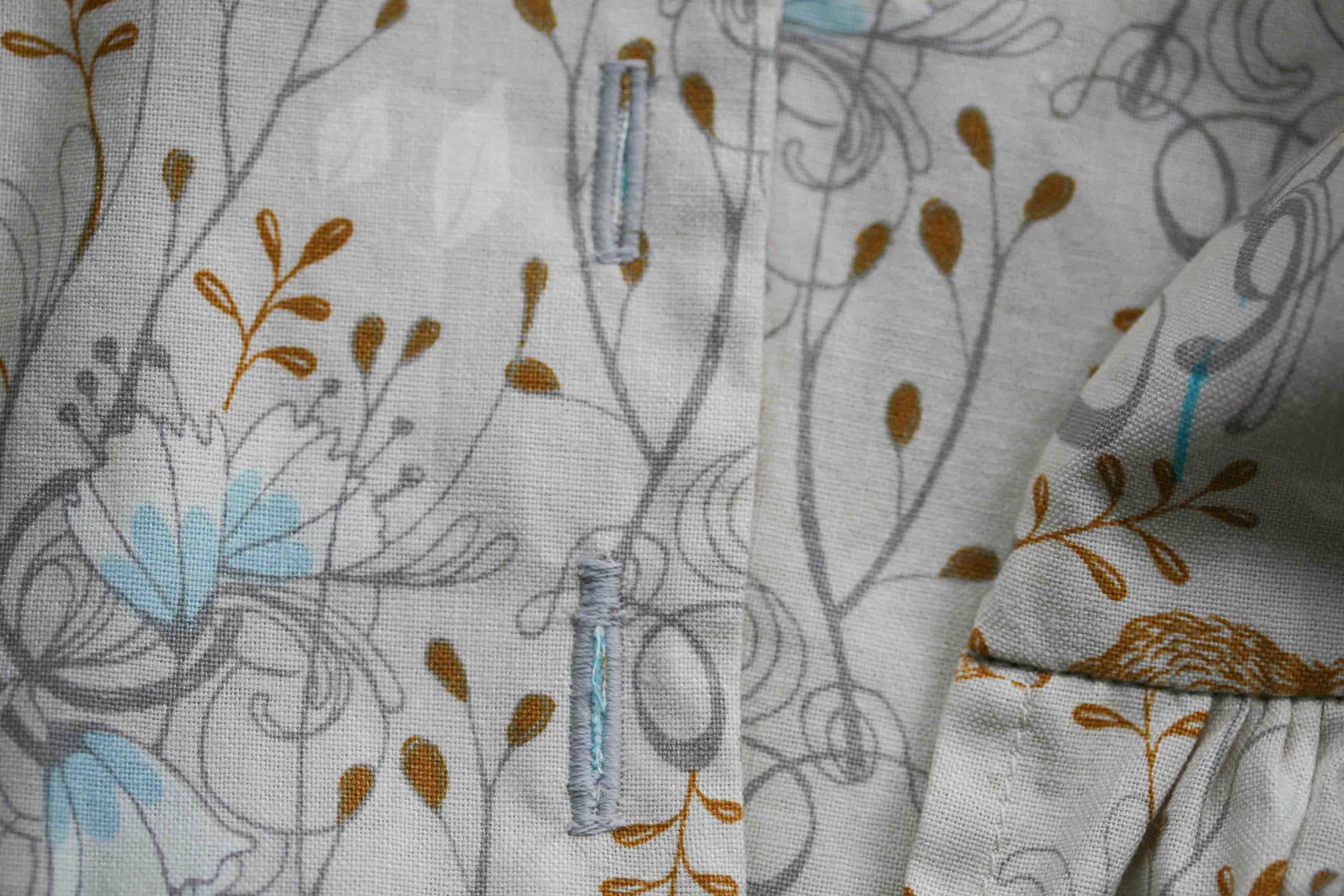
And sadly it is only one example of how perfectionism affects my making. I have included a couple of pictures from a dress I made for xmas for my gorgeous niece. I love her and so I want what I make for her to be “perfect” – and I made a mistake. Right at the end when I had finished all the sewing. I took my unpicker to open up the buttonholes and sliced right through the end of one. I did some quick dodgy fixing which you can hardly see. But was still super sad because I wanted to give her something “perfect”.

It’s like my head /heart completely misses the point of making and giving. That the recipient won’t care that it isn’t perfect. That they will feel loved because of the making. That they won’t even notice the small issue. I still felt disappointed. And to me the gift was a little bit ruined. The wacky behaviour then went a little bit further - I also then had to tell my SIL about the mistake so she knew that I knew that it wasn’t perfect. Arrrgghhhh!!!

I couldn’t be proud of what I had made for her. Instead I was almost ashamed that it wasn’t perfect. And I had to let her know.

More nuts-ness!!

Handmade gifting in action - my girl feeling the love in her new birthday socks!

Handmade gifting in action - my girl feeling the love in her new birthday socks!

I often find that when this fear is particularly strong in me, that I spend more time thinking and dreaming about projects rather than doing them. I spend more time dreaming about my perfect wardrobe and building my visual diary than making it a reality because the dreaming part of it is free from disappointment. It is all about the potential. In my head things are perfect. Each frock I make myself fits perfectly.

But this is a really empty process because the buzz of potential never translates into actual making and actual outcomes. It is all bubbles and no champagne. And by wasting my time on this "potential" feeling I don’t get the longer term, ultimately more satisfying joy of having made things. And I also miss out on the joy of practicing my craft – which is a different sort of joy again. And practicing means my skills are improving over time, which means I am more likely to achieve the outcomes I am looking for.

Instead I am left with procrastinators regret. The feeling of knowing that if I had spent my time a little differently I would have a different outcome.

The thing that Catherine Deveny simply asked was "have you ever failed?" and then quickly followed up with "and did it kill you?" Just the sort of perspective I needed to hear. What is there to be afraid of? Disappointment can't kill me. Who knew??

Through watching myself this last year I have found that I don’t start, don’t make and don’t complete the projects that are really important to me. Instead I prioritise smaller, simpler and less important projects as they mean I can feel like I have achieved while avoiding dissappointment. Out of fear! In doing this I am wasting my time, my ideas, my opportunity to live my life the way that is a true reflection of what is important to me.

So - 2014 is the year of completionism!

I will be watching myself for this kind of (wacky) procrastination and fear-based behaviour. And when I see it, I’ll be practicing my little heart out to complete things. Completion will be the name of the game to see if I can get a bit closer to living a life free from the expectation of perfection and it's subsequent disappointment.

I’d love to hear your thoughts!

Felicia x 

*I have found that this stuff affects all of my life (putting on The Craft Sessions for example involved a massive step outside my comfort zone) but as this is a crafting blog I am focusing on that.


In Thoughts On Craft
25 Comments
← Newer Posts Older Posts →

Welcome! I'm Felicia - creator of The Craft Sessions and Soul Craft Festival.

This blog aims to celebrate the connection between hand-making and our well-being.
These posts aim to foster a love of hand-making and discuss the ways domestic handcrafts elevate our everyday.

I love the contributions you make to this space via your comments and learn so much from each and every one. x

Thoughts On Craft

Simple Sewing 101

Stash Less

The RetreaT

Featured
Making Fast Fashion: Some More Of The Grey
Apr 19, 2022
Making Fast Fashion: Some More Of The Grey
Apr 19, 2022
Apr 19, 2022
Is My Making Fast Fashion?
Apr 12, 2022
Is My Making Fast Fashion?
Apr 12, 2022
Apr 12, 2022
Why Gauge Matters
Apr 5, 2022
Why Gauge Matters
Apr 5, 2022
Apr 5, 2022
Craft As Simple Mundane Forward Movement
Mar 29, 2022
Craft As Simple Mundane Forward Movement
Mar 29, 2022
Mar 29, 2022
Craft As A Virtuous Cycle*
Mar 22, 2022
Craft As A Virtuous Cycle*
Mar 22, 2022
Mar 22, 2022
Craft & The Slow Nostalgic Finish
Mar 15, 2022
Craft & The Slow Nostalgic Finish
Mar 15, 2022
Mar 15, 2022

popular posts

Craft As A Project V’s Craft As A Practice

Our Fear Of Going Back

Making Is Not Inherently Creative

Why All Crafters Need A Visual Diary

Craft As A Manifestation Of Love And Loss

Moving On From Perfectionism

The Secret To Becoming A Great Knitter!

Simple Sewing 101 - Part 1

Craft In The Middle Of Motherhood

Another #theyearofthescrap #ellenscardigan using some #oldmaidenaunt alpaca silk from many years ago. What I love about this little cardy is it’s simplicity and how little yarn it uses. Perfect for scrap knitting. I now have a little pile of ba
New blog post: Craft as elevating the mundane! I think this idea is so important. 🌿 'Making is about enriching the moments of our lives; it’s about making the mundane (and not the extraordinary) more abundant and that bit more lush…. el
Block 8/12 - I’m so excited to be back making this for my smallest for her 10th birthday. It’s a #stash_less #theyearofthescrap quilt that is based on an incredible #geesbend quilt. And it’s all scraps and precious bits and pieces.
Another #theyearofthescrap #ellenscardigan using some #oldmaidenaunt alpaca silk from many years ago. What I love about this little cardy is it’s simplicity and how little yarn it uses. Perfect for scrap knitting. I now have a little pile of ba New blog post: Craft as elevating the mundane! I think this idea is so important. 🌿 'Making is about enriching the moments of our lives; it’s about making the mundane (and not the extraordinary) more abundant and that bit more lush…. el Block 8/12 - I’m so excited to be back making this for my smallest for her 10th birthday. It’s a #stash_less #theyearofthescrap quilt that is based on an incredible #geesbend quilt. And it’s all scraps and precious bits and pieces.
The Blog Archives!
  • April 2022
  • March 2022
  • February 2022
  • December 2021
  • March 2021
  • February 2021
  • November 2020
  • July 2020
  • June 2020
  • May 2020
  • April 2020
  • March 2020
  • February 2020
  • December 2019
  • March 2019
  • February 2019
  • January 2019
  • December 2018
  • November 2018
  • October 2018
  • August 2018
  • July 2018
  • May 2018
  • April 2018
  • March 2018
  • February 2018
  • January 2018
  • December 2017
  • November 2017
  • October 2017
  • September 2017
  • August 2017
  • July 2017
  • June 2017
  • May 2017
  • April 2017
  • March 2017
  • February 2017
  • January 2017
  • November 2016
  • October 2016
  • September 2016
  • August 2016
  • July 2016
  • June 2016
  • May 2016
  • April 2016
  • March 2016
  • February 2016
  • January 2016
  • December 2015
  • November 2015
  • October 2015
  • September 2015
  • August 2015
  • July 2015
  • June 2015
  • May 2015
  • April 2015
  • March 2015
  • February 2015
  • January 2015
  • December 2014
  • November 2014
  • October 2014
  • September 2014
  • August 2014
  • July 2014
  • June 2014
  • May 2014
  • April 2014
  • March 2014
  • February 2014
  • January 2014
  • December 2013
  • November 2013
  • October 2013
  • September 2013
  • August 2013
  • July 2013
  • June 2013
Featured
Making Fast Fashion: Some More Of The Grey
Apr 19, 2022
Making Fast Fashion: Some More Of The Grey
Apr 19, 2022
Apr 19, 2022
Is My Making Fast Fashion?
Apr 12, 2022
Is My Making Fast Fashion?
Apr 12, 2022
Apr 12, 2022

We Live and work on the traditional lands of the Wurundjeri people of the Kulin nation.
We acknowledge that sovereignty was never ceded and pay our respect to elders past, present and emerging.

Copyright the Craft Sessions 2020

Logo designed by the lovely Mara of Printspace and Girling Design